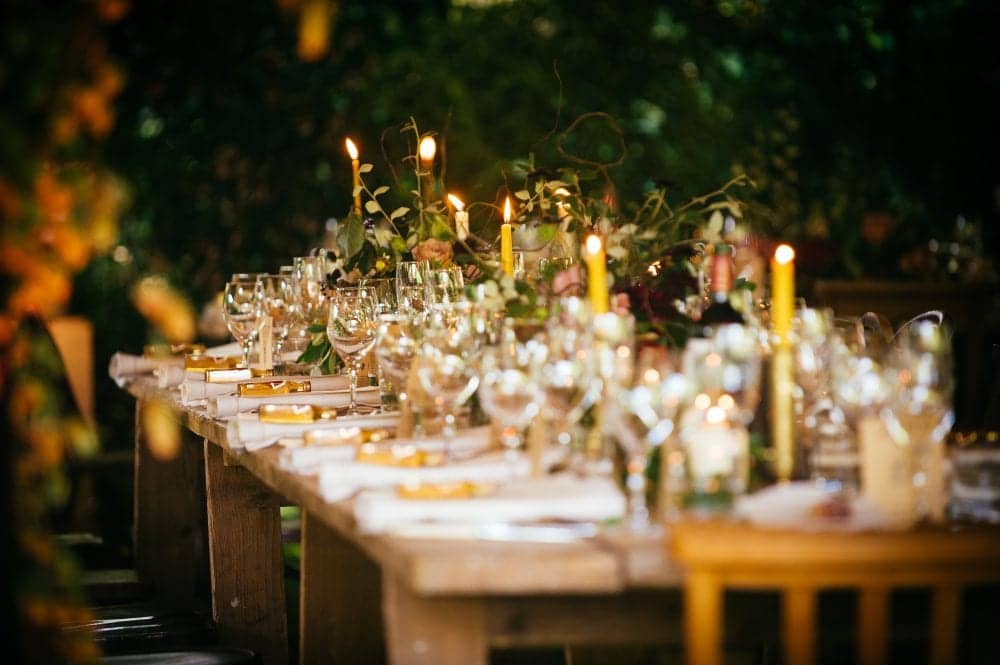
Some rooms only become interesting when the lights go out.
Lighting can make a vast building feel intimate, turn a familiar garden into somewhere unrecognisable and change the entire direction of an evening without moving a single wall.
It is one of the most powerful materials we work with.
And unlike flowers or furniture, guests often never consciously notice it.
Never design the night in daylight
A venue visit at eleven in the morning can be deeply misleading.
Windows that flood a room with daylight become black mirrors. Architectural details disappear. Corners become voids. A ceiling you barely noticed suddenly dominates everything.
Equally, things you disliked can vanish completely.
At night, you decide what exists.
Start with darkness
The instinct is to add light everywhere.
Resist it.
Not every wall deserves attention. Not every tree needs uplighting. Not every table needs to glow at the same level.
Contrast creates intimacy and drama.
A pool of warm light feels beautiful because something around it is darker. An artist stepping into light is theatrical because they have emerged from shadow.
Darkness is not an absence of design. It is one of the design tools.
Candlelight still wins
There is a reason candlelight survives every technical innovation.
It moves. It flatters. It makes glass, silver, skin and old stone behave differently.
But candlelight needs confidence.
Three apologetic votives rarely change a room. Hundreds of flames at different heights can.
Where real flame is not possible, the alternative needs the same attention to colour temperature, placement and quality.
“More candles” is not the idea. Atmosphere is.
Reveal the architecture
At night, lighting can show guests a building they did not see when they arrived.
Stonework, columns, trees, arches, ceilings and sculpture can appear gradually as the evening changes.
The temptation is to illuminate everything impressive.
Often one perfectly lit tree is more memorable than twenty. A narrow wash across old stone can be more beautiful than bathing an entire façade in colour.
Editing matters after dark too.
Change the world after dinner
Dinner and dancing should not live under the same light.
Dinner wants warmth, faces, food and intimacy.
A party can become darker, stranger, more saturated and more kinetic.
The transition between the two can be almost imperceptible.
The final plate disappears. The room falls slightly. The music shifts. Somewhere else begins to glow.
Nobody announces what is happening.
Guests simply know it is time to move.
Let the photographs become less perfect
The photographs at the beginning of an evening are immaculate.
By midnight, the candles are lower, napkins are on chairs, hair is down, jackets have disappeared and the images begin to blur with movement.
They are often the better photographs.
An event is not an installation. It is supposed to be inhabited.
Lighting creates the conditions in which guests stop looking at the room and become part of it.
That is when design becomes atmosphere.